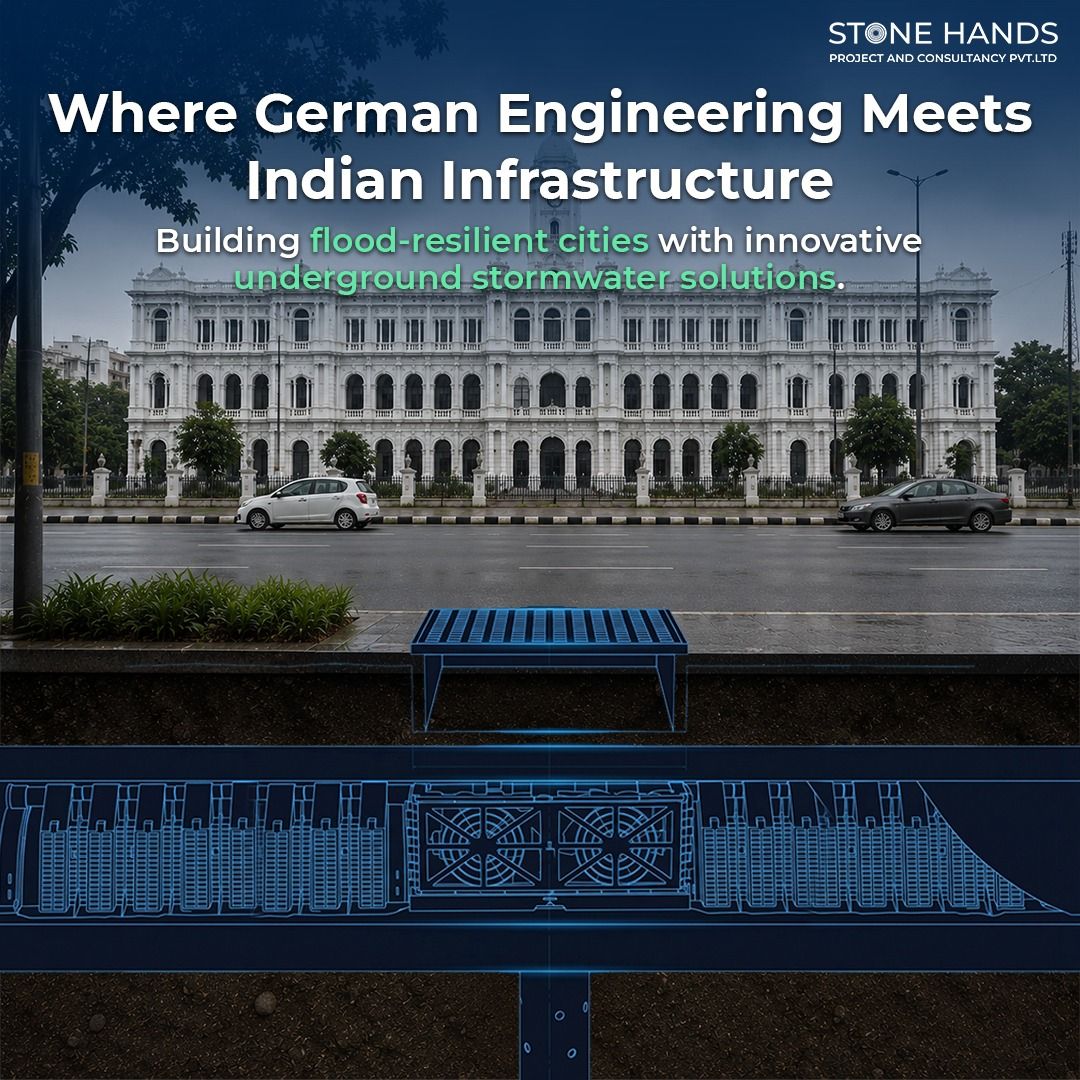
Where German-Inspired Engineering Fits Indian Infrastructure Needs
08 July 2026
Where German-Inspired Engineering Fits Indian Infrastructure Needs
Indian infrastructure planners sometimes approach European engineering solutions with reasonable scepticism: does technology designed for temperate, low-intensity rainfall environments actually perform in India's high-intensity monsoon conditions, diverse soil types, and demanding construction environments? Stone Hands has spent over a decade answering that question with evidence. The Eco Bloc modular stormwater system — German-engineered HDPE subsurface infrastructure — performs not despite Indian conditions, but because it was selected precisely for them. This article explains the technical case, the performance record, and the specific reasons why German-engineered stormwater infrastructure is well-suited to India's urban development context.
The Scepticism — and Why It Is Worth Engaging
"German rainfall is nothing like Indian monsoon conditions." True. German peak intensities: typically 30–60mm/hour. Indian monsoon peak intensities in Chennai, Mumbai, Hyderabad: regularly 100–150mm/hour. The question is not whether the technology was designed for the same rainfall — it was not — but whether it can be correctly sized for Indian conditions. Answer: Yes. Eco Bloc systems are sized using local Indian IDF data. The technology is modular — storage volume is whatever the design requires.
"Indian soils are different." Also true — ranging from high-permeability black cotton soil to dense clay. Stone Hands sizes every system based on site-specific soil permeability testing. Works across the full range.
"Indian construction environments are less controlled." A fair observation. Eco Bloc is specifically suited to Indian construction conditions: lightweight units, no specialist equipment, rapid assembly, high tolerance to construction sequence variations.
What German Engineering Brings to Indian Infrastructure
Material quality: German HDPE manufacturing standards produce consistent void ratio, load performance, and chemical resistance. Indian market alternatives vary significantly.
Load certification: 60-ton load rating is independently tested and certified — not a manufacturer claim.
Connection system design: engineered for long-term performance — preventing silt ingress and joint failure that characterise cheaper alternatives.
Lifecycle performance: deployed in European urban infrastructure since the 1990s — 30-year performance record that is evidenced, not theoretical.
Proven in Indian Conditions — The Chennai Record
Stone Hands has deployed Eco Bloc systems across multiple Greater Chennai Corporation sponge park projects, through multiple monsoon seasons. Chennai conditions:
• Annual rainfall: 1,200–1,500mm, concentrated in northeast monsoon (Oct–Dec)
• Peak intensity: regularly exceeding 100mm/hour during cyclonic events
• Soil: predominantly clay and filled ground in urban areas
Results: systems performed as designed — absorbing peak stormwater volume, recharging groundwater, maintaining structural integrity under road and park maintenance loads.
https://stonehands.in/solutions
Where the Fit Is Strongest
High-load applications: sub-road, sub-parking, industrial yard — where 60-ton load rating delivers performance Indian-manufactured alternatives cannot match.
Large-scale municipal programmes: quality consistency across many installations matters — GCC's programme requires same performance standard at every site.
Long-duration projects: developments where the stormwater system must perform for 50+ years without replacement.
Sensitive site environments: where system failure carries significant cost or consequence.
FAQs
Q1: Is Eco Bloc manufactured in India or imported?
A: Stone Hands can advise on current supply chain arrangements. Design, performance standards, and quality specifications are based on German engineering standards regardless of manufacturing location.
Q2: Is there a price premium compared to local alternatives?
A: Typically a unit cost premium over lowest-cost Indian alternatives. Recovered in higher void ratio (less material needed), longer lifespan, and lower risk of performance failure.
Q3: How does Stone Hands ensure quality control on Indian sites?
A: Stone Hands provides technical supervision during installation — verifying correct assembly, inlet connection quality, geotextile installation, and backfill specification.
Q4: Can German engineering standard be demonstrated to a client or planning authority?
A: Yes. Stone Hands provides technical documentation including material specifications, load test certificates, and relevant European standards references.
Q5: Is this technology used elsewhere in Asia besides India?
A: Yes — deployed across Singapore, Malaysia, Japan, Australia, and China, all high-rainfall environments.
Q6: What is Stone Hands' relationship with the German technology?
A: Stone Hands has over a decade of experience implementing Eco Bloc technology in Indian urban infrastructure, with a track record including municipal, residential, industrial, and institutional clients.
If you are evaluating stormwater infrastructure options and want to understand the technical case for German-engineered Eco Bloc systems, contact Stone Hands for a consultation.
→ https://stonehands.in/solutions
Contact Us
Join us to
Shape a Water secure future
We'd love to hear from you. Fill out the form and our team will get back to you within 24–48 hours.
Prefer a Direct Approach?
+91 82200 02200
Contact@stonehands.in