31 August 2026
The ₹561 Billion Drainage Push: What It Means for Indian Cities
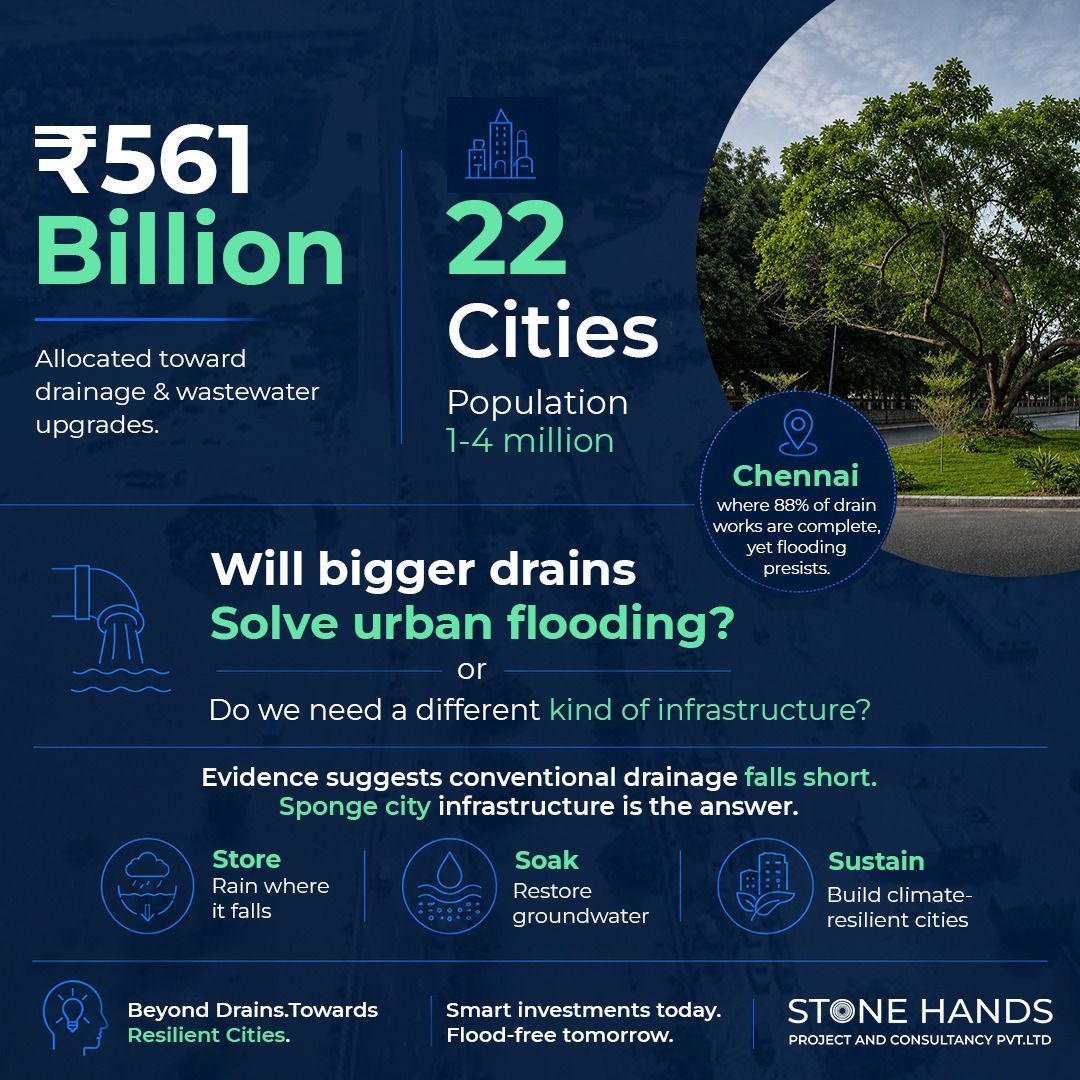
The Sixteenth Finance Commission has allocated ₹561 billion toward drainage and wastewater upgrades across 22 Indian cities with populations between one and four million — one of the most targeted urban water infrastructure investments in recent years. For municipal planners and infrastructure consultants, this raises an immediate question: will bigger drains actually solve urban flooding, or does the money need to go toward a different kind of infrastructure entirely? Evidence from cities that have already spent heavily on conventional drainage — Chennai included, where the Greater Chennai Corporation reports 88% of stormwater drain works complete yet flooding persists — suggests the answer is not simply more concrete. This article looks at what the grant covers, where conventional drainage falls short, and where Sponge City infrastructure fits into the national conversation.
What the Grant Actually Covers
The Sixteenth Finance Commission's special infrastructure component allocates ₹561 billion specifically for drainage and wastewater upgrades across 22 cities with populations between one and four million. This is targeted funding, not a general urban development grant — it is meant to fund the physical infrastructure that manages stormwater and wastewater, which puts engineered solutions like modular infiltration and Sponge City systems squarely within scope, alongside conventional drain network upgrades.
Why More Drains Alone Won't Be Enough
Chennai offers a cautionary data point: the Greater Chennai Corporation reports 88% of stormwater drain works complete, having spent ₹6,475 crore over four years, yet flooding continues every monsoon in the same neighbourhoods. Bigger drains move water faster downstream — they do not reduce the volume of runoff being generated in the first place, and they provide zero groundwater recharge. Cities that pair drainage upgrades with source-control infrastructure — permeable surfaces, subsurface storage, distributed infiltration — see runoff volume actually reduced, not just relocated.
Where Sponge City Infrastructure Fits Into Municipal Funding
The ₹561 billion Finance Commission allocation is not the only funding stream available for urban flood mitigation infrastructure — it sits alongside the Smart Cities Mission's urban flood resilience component, AMRUT 2.0's water body rejuvenation and stormwater management provisions, and state-level disaster management funds. Municipal planners evaluating how to deploy this funding effectively should note that Sponge City solutions in India — subsurface storage, permeable surfaces, and distributed infiltration — are eligible under multiple these programmes simultaneously, not just the drainage-specific grant. Stone Hands has direct experience navigating this funding landscape through its work on the Greater Chennai Corporation's sponge park programme, including technical specification support for tender documentation and coordination with municipal engineering departments. For a city evaluating how to allocate drainage infrastructure funding, the practical question is not whether to spend on conventional drains versus source-control infrastructure — it is how to combine both within a single coordinated programme, so that new drainage capacity is matched with reduced runoff volume at the source, rather than simply moving the same volume of water faster downstream.
FAQs
Q: Which cities are covered by the grant?
A: 22 Indian cities with population between 1 and 4 million, as designated by the Sixteenth Finance Commission.
Q: Does the grant fund private projects?
A: The grant targets municipal infrastructure; private developments remain governed separately by RERA and local building codes.
Q: How does Sponge City infrastructure fit into this funding?
A: As part of an integrated approach — drainage upgrades funded by the grant, paired with subsurface storage and infiltration systems for source-control.
Contact Us
Join us to
Shape a Water secure future
We'd love to hear from you. Fill out the form and our team will get back to you within 24–48 hours.
Prefer a Direct Approach?
+91 82200 02200
Contact@stonehands.in