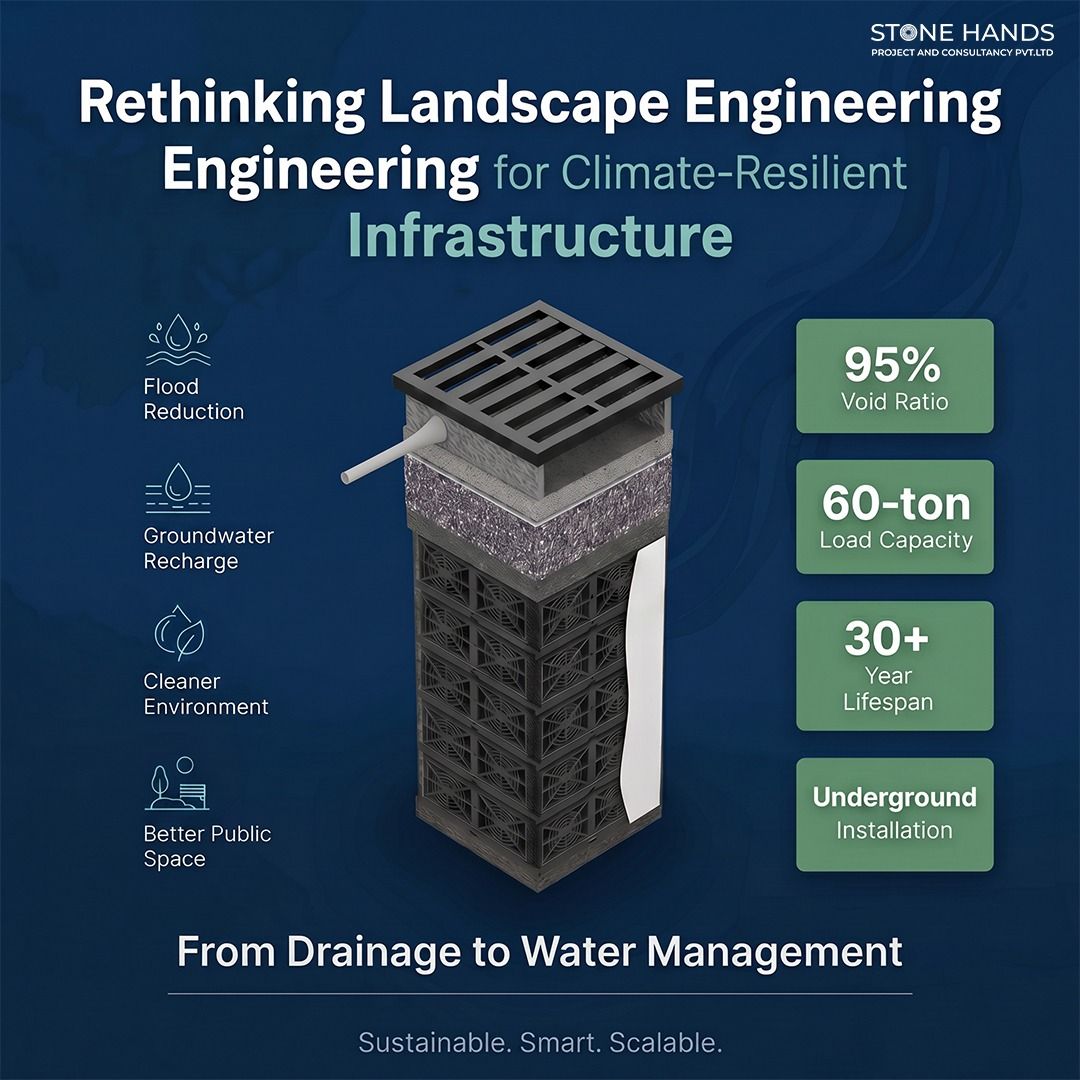
Rethinking Landscape Engineering for Climate-Resilient Infrastructure
29 April 2026
Rethinking Landscape Engineering for Climate-Resilient Infrastructure
Landscape engineering in India has long meant drainage — how to get water off the surface and into the pipe as fast as possible. That question is now the wrong one. Climate-resilient infrastructure asks: how do we manage water where it falls, reduce its velocity before it reaches the drain, and use it productively before it is lost? The Eco Bloc modular system from Stone Hands is the technology at the centre of this transition — a German-engineered subsurface storage and infiltration system that transforms landscape engineering from a drainage exercise into a water management strategy.
Why Conventional Landscape Drainage Is Failing
Three compounding changes:
1. Rainfall intensity has increased — climate change delivering more intense, shorter-duration storm events
2. Urban catchments have grown — new development upstream constantly increases runoff volume
3. Regulatory expectations have risen — RERA, Smart City programmes, and municipal codes now require on-site stormwater management
From Drainage to Water Management
Climate-resilient infrastructure incorporates four functions conventional drainage ignores:
1. Attenuation — slowing peak runoff rate before it reaches drains
2. Storage — holding storm volume underground during peak event
3. Infiltration — returning water to soil and aquifer
4. Reuse — harvesting stored water for productive use
The Eco Bloc modular system performs all four within the landscape footprint — no surface impact, 30+ year operational life.
Eco Bloc Modular System — Technical Detail
Engineering properties:
• Material: Recycled polypropylene — chemically inert, UV-stable, corrosion-resistant
• Void ratio: 95% — most storage-efficient modular system available
• Load capacity: up to 60 tons — any urban surface load condition
• Lifespan: 50+ years with standard maintenance
Installation sequence: Excavation → granular sub-base → geotextile liner (permeable) → Eco Bloc units assembled → inlet and overflow structures → geotextile wrapped over top → granular cover or concrete slab → surface reinstatement.
https://stonehands.in/solutions
Applications in Landscape Engineering
Sports and recreation surfaces: eliminates waterlogging, extends usable season
Green roofs and podium landscapes: drainage and storage layer beneath planting medium
Tree pit design: structural support + moisture reservoir for roots, reduces irrigation demand
Road and path surfaces: within narrow installation footprint
FAQs
What makes Eco Bloc different from a gravel soakaway?
A: Gravel has ~30–35% void ratio. Eco Bloc has 95% — nearly 3× the storage per cubic metre. Eco Bloc is also structurally load-bearing (60 tons); gravel is not.
Is it approved under Indian building regulations?
A: Stone Hands provides design documentation for regulatory submission. System deployed in GCC municipal projects.
How is the system sized?
A: Catchment area, design storm return period, and soil permeability used to calculate required storage volume.
Can it be combined with rainwater harvesting?
A: Yes — sealed sump within system for pumped reuse, configurable for recharge only, reuse only, or combination.
What about water quality and mosquito risk?
A: System typically empties within 24–72 hours. Geotextile filtration at inlet removes gross sediment. No conditions for mosquito breeding.
Is German engineering certification available?
A: Stone Hands' Eco Bloc is based on German technology certified to European urban infrastructure standards.
Contact Us
Join us to
Shape a Water secure future
We'd love to hear from you. Fill out the form and our team will get back to you within 24–48 hours.
Prefer a Direct Approach?
+91 82200 02200
Contact@stonehands.in