13 April 2026
Public Space Design Opportunities for Municipalities and Civic Bodies
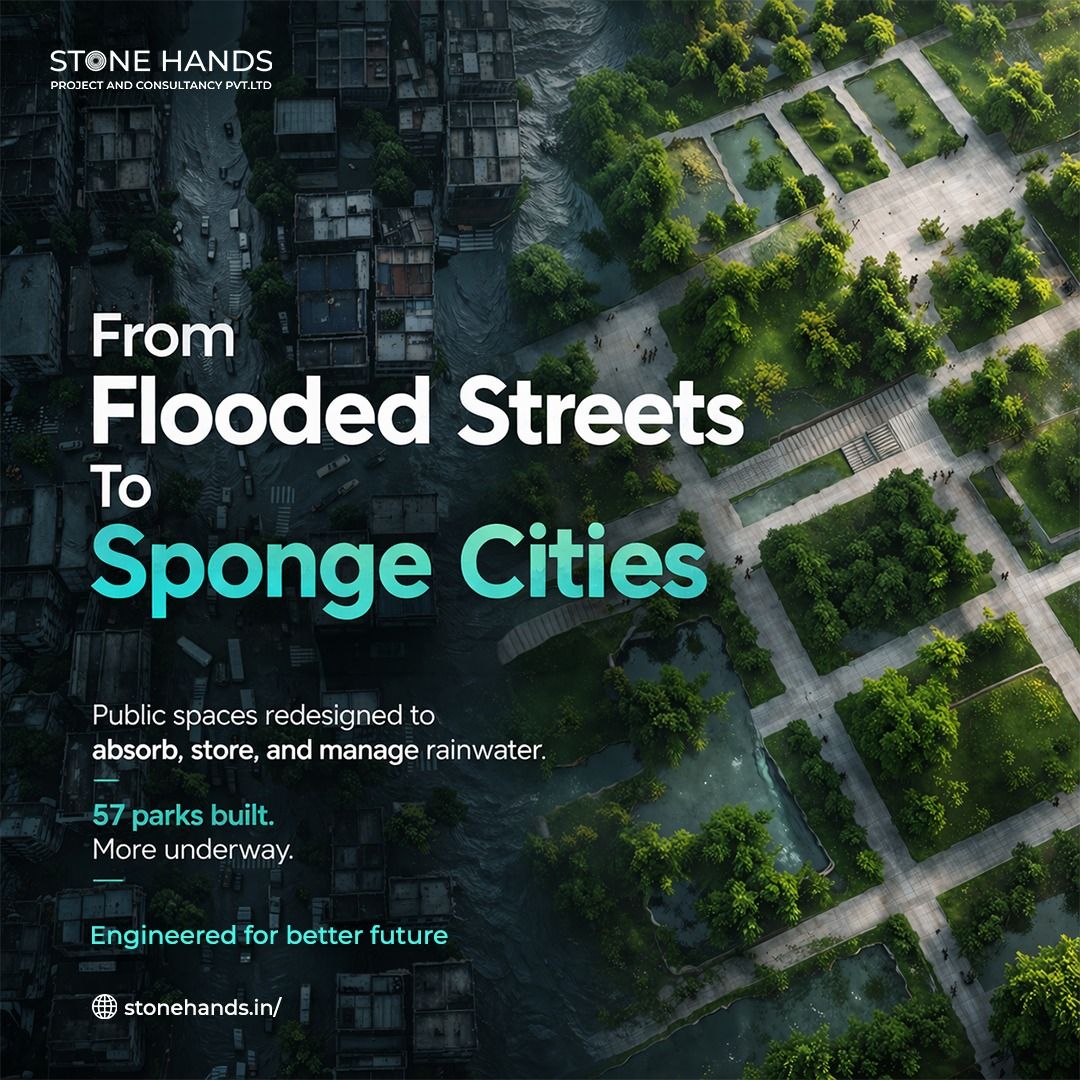
Municipal corporations and civic bodies hold the most underused water management asset in any Indian city: public open space. Parks, plazas, road medians, temple tank surrounds, community grounds — these spaces receive rainfall, generate runoff, and contribute to neighbourhood flooding. Redesigned as Sponge City infrastructure, the same spaces absorb rainfall, recharge groundwater, and protect surrounding areas from flooding. Greater Chennai Corporation's sponge park programme — in which Stone Hands holds a contract for the RA Puram sponge park — demonstrates what is possible at scale.
The Chennai Model
GCC's sponge park programme:
• 57 sponge parks built in 2023–24
• 30 additional planned for 2024–25
• ₹88 crore budgeted for seven new parks in 2025–26
• Technology: permeable stone chip paving + Eco Bloc subsurface storage
• Objective: urban flood mitigation and groundwater recharge across Chennai's residential neighbourhoods
FAQs
What is the cost per sponge park installation?
A: Depends on park size, system capacity, and existing drainage infrastructure. GCC's programme has demonstrated cost-effective delivery at scale.
How long does a sponge park installation take?
A: A typical neighbourhood park of 1–3 acres: 6–12 weeks, subject to site access and existing utility clearances.
Does converting a park affect public access during construction?
A: Park is typically closed during installation. Stone Hands coordinates phased programme to minimise duration where required.
The Opportunity — Civic Stormwater Asset Inventory
Parks: Every park can be a sponge park. Priority: parks in flood-prone neighbourhoods.
Road medians and verges: Linear Eco Bloc installations in median strips create distributed groundwater recharge at neighbourhood scale.
Temple tank surrounds: Traditional function of temple tanks — groundwater recharge and flood attenuation — restored and augmented with subsurface infrastructure around the tank perimeter.
Community and recreation grounds: Large-footprint sites ideal for low-disruption Eco Bloc installation.
https://stonehands.in/solutions
Implementation at Municipal Scale
Stone Hands has experience with full municipal project cycle: technical specification for tender documentation | hydrological assessment and system design for individual park sites | coordination with municipal engineering departments | supply and installation of Eco Bloc systems | post-installation documentation and O&M handover | compliance with GCC and CMDA project standards.
Funding and Policy Context
Municipal Sponge City infrastructure eligible for: Smart Cities Mission (urban flood resilience component) | AMRUT 2.0 (water body rejuvenation and stormwater management) | NABARD urban infrastructure lending | State disaster management funds.
If you are a municipal planner, elected representative, or civic infrastructure consultant exploring Sponge City implementation, contact Stone Hands for a programme briefing.
→ https://stonehands.in/solutions
Can this work for smaller municipalities?
A: Yes. Scalable to any size of municipality and any rainfall context.
How does this connect to neighbourhood-scale groundwater recharge?
A: Multiple sponge parks distributed across a neighbourhood create a distributed recharge network. Cumulative effect on water table levels measurable over 3–5 years.
Is Stone Hands' Chennai GCC work documented for reference?
A: Yes. Stone Hands can provide references and project documentation from the GCC programme for municipal clients.
Contact Us
Join us to
Shape a Water secure future
We'd love to hear from you. Fill out the form and our team will get back to you within 24–48 hours.
Prefer a Direct Approach?
+91 82200 02200
Contact@stonehands.in