Eco Bloc vs Traditional Soak Pits — A Comparison
02 September 2026
Eco Bloc vs Traditional Soak Pits — A Comparison
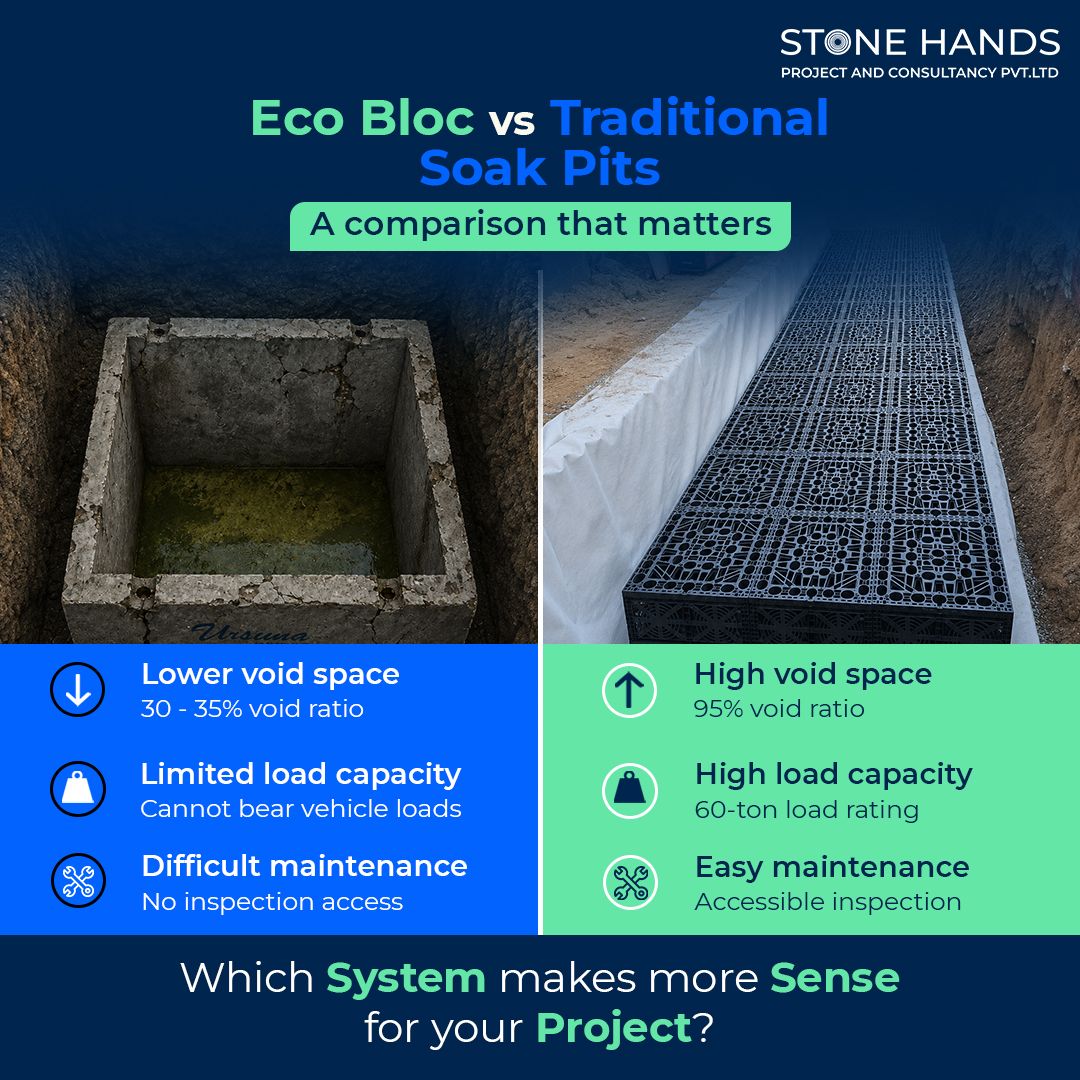
Traditional soak pits and gravel-filled soakaways have been the default stormwater infiltration solution in India for decades, largely because they are cheap and simple to build. But cheap and simple comes with real trade-offs: gravel soakaways offer only 30-35% void ratio, cannot bear vehicle loads, and typically fail within 5-8 years as silt accumulates with no maintenance access. Eco Bloc, a modular recycled-polypropylene system, offers 95% void ratio — nearly three times the storage per cubic metre — a 60-ton load rating suitable beneath roads and parking, and a 50+ year lifespan with accessible inspection chambers. This article compares the two systems directly across the factors that actually matter for a project decision: storage efficiency, structural capacity, maintenance, and total lifecycle cost.
Storage Efficiency and Load Capacity
A gravel soakaway has roughly 30-35% void ratio, meaning most of the excavated volume is filled with stone rather than usable storage space, and it cannot support vehicle loads without a separate structural slab. Eco Bloc's 95% void ratio delivers nearly three times the storage per cubic metre excavated, and its modular units carry a certified 60-ton load rating on their own — suitable for direct installation beneath car parks and access roads without additional structural work.
Lifespan and Total Cost
Concrete soakaways and brick-lined pits typically fail within 5-8 years as acidic runoff degrades the material and silt accumulation reduces capacity, usually with no inspection access to catch the problem early. Eco Bloc's recycled polypropylene is chemically inert and does not corrode under the same conditions, giving it a documented 50+ year service life with accessible inspection chambers for maintenance. The higher unit cost of a modular system is typically offset within the first few years by avoided replacement and drainage failure costs.
Which Option Is Right for Your Project
The right choice between a traditional soak pit and a modular system like Eco Bloc depends heavily on project type. For a small residential plot with light surface loading and a modest budget, a well-designed gravel soakaway may still be adequate, provided it includes proper silt management at the inlet. For anything involving vehicle traffic — car parks, driveways, access roads — a modular water storage tank with certified load-bearing capacity becomes close to essential, since gravel systems have no structural rating and will fail under repeated loading. Commercial and industrial projects generally require underground rainwater harvesting systems sized to a proper design storm return period, where the storage efficiency of a 95% void ratio system directly reduces excavation footprint and cost compared to gravel's 30-35%. High load-bearing 60-ton tank systems are specifically suited to municipal and industrial applications where heavy vehicle access is a given, not an exception. The general pattern: the more structural load, catchment area, or regulatory scrutiny a project faces, the stronger the case for a modular system over a traditional soakaway.
FAQs:
Q: Which option costs less upfront?
A: Gravel soakaways are cheaper initially, but the lifecycle cost usually favours modular systems given the 5-8x difference in service life.
Q: Can a failed soakaway be replaced with Eco Bloc in the same footprint?
A: Yes — this is a standard upgrade path, with substantially higher capacity in the same excavation.
Q: Does Eco Bloc need different soil conditions?
A: System sizing is adjusted for site-specific soil permeability, so it works across the full range of Indian soil types including clay.
Contact Us
Join us to
Shape a Water secure future
We'd love to hear from you. Fill out the form and our team will get back to you within 24–48 hours.
Prefer a Direct Approach?
+91 82200 02200
Contact@stonehands.in