04 April 2026
Designing Stormwater Systems for Campuses, Parks, and Public Spaces
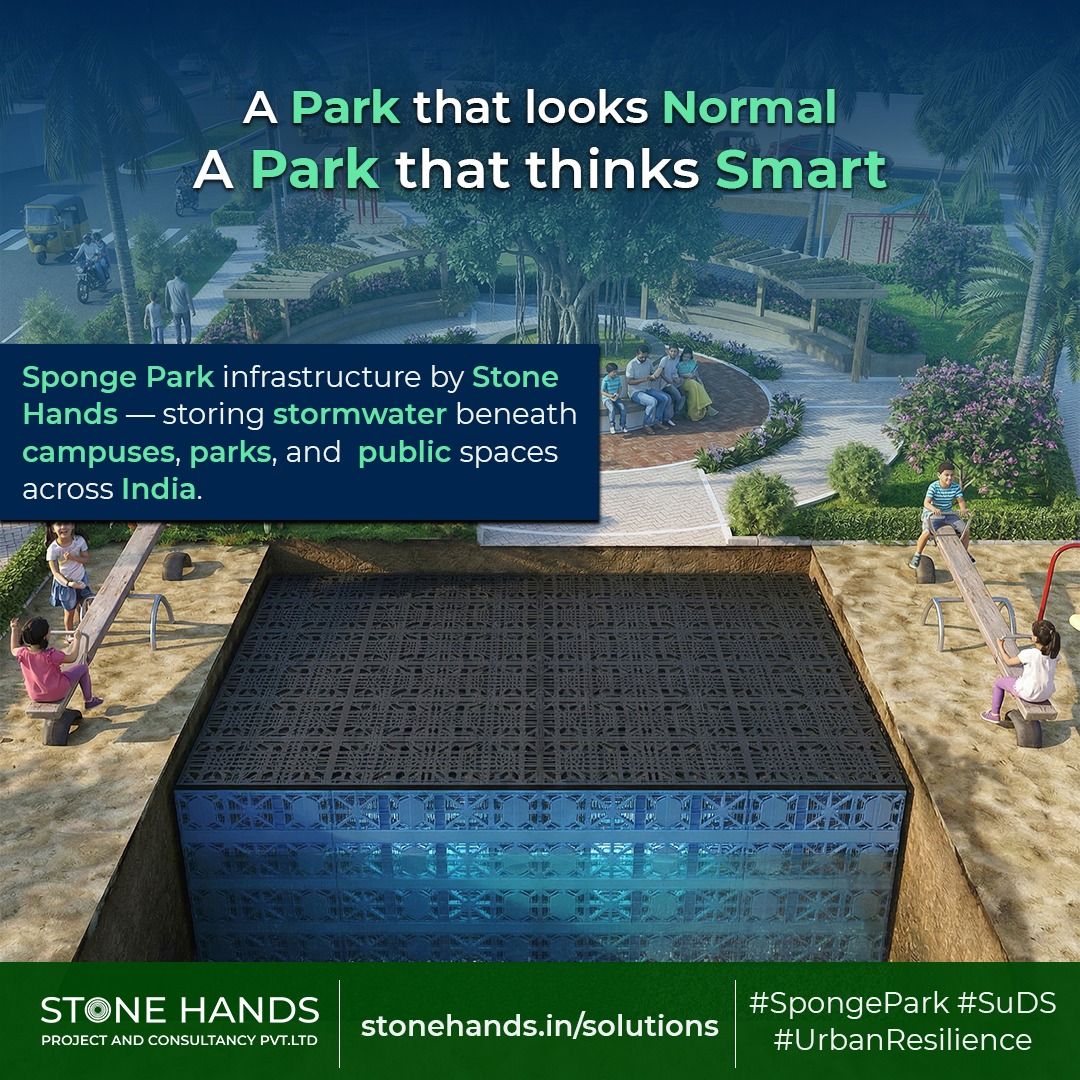
A university campus, a public park, a sports facility, a civic plaza — these are large-footprint urban sites with substantial hardscaped and landscaped areas that generate significant runoff. When designed with Sponge Park infrastructure principles, these same spaces become functional stormwater management assets — absorbing rainfall, recharging groundwater, and reducing flood risk for the surrounding neighbourhood. Stone Hands designs and installs Eco Bloc-based sponge park and campus stormwater systems for institutional, municipal, and commercial clients across India.
The Problem — Public Spaces as Unintentional Flood Generators
Without stormwater management design, campuses and parks:
• Export peak runoff to adjacent streets within minutes of heavy rain
• Contribute to downstream flooding in residential neighbourhoods
• Experience surface waterlogging that damages turf, plantings, and infrastructure
• Provide no groundwater recharge despite substantial open space
GCC recognised this when it began converting public parks into sponge parks — functioning as recreation spaces above and water management infrastructure below.
FAQs
Does installing Eco Bloc beneath a park damage the landscape?
A: No — surface reinstated to original appearance post-installation.
Can existing parks be retrofitted?
A: Yes, but requires excavation. Most cost-effective during initial construction or planned renovation.
Is this the same technology used in Chennai's GCC sponge parks?
A: Yes. Stone Hands uses Eco Bloc — the German-engineered technology specified in GCC's programme, including RA Puram.
What surface treatments are compatible?
A: Natural stone chip paving, permeable concrete, grass paving, standard drainage-connected hard surfaces.
How is the system sized for a campus?
A: Stone Hands calculates design storm runoff from hard surface catchment, soil permeability, and peak rainfall data.
Can stored water be reused for campus irrigation?
A: Yes — connected to a collection sump for pumped reuse. Increasingly standard in green campus projects.
The Concept — Sponge Park Infrastructure
A sponge park integrates standard landscape design with a subsurface stormwater management layer:
• Permeable surface treatments allow water to enter the system
• Geotextile filter layer at surface prevents silt from entering storage
• Eco Bloc units below create the storage and infiltration layer
• Overflow outlets connect to existing drainage for extreme events
• System sized to capture runoff from a design storm of defined return period
Eco Bloc in Landscape Applications
Beneath soft landscape areas: Under lawns, playing fields, and planted areas, Eco Bloc provides subsurface storage without affecting surface use. 60-ton load rating means maintenance vehicles can pass over without damage.
Beneath hard surface areas: Under car parks, service roads, pedestrian plazas — storage invisible from the surface.
https://stonehands.in/solutions
Applications
Educational campuses (NAAC/NIRF green criteria) | Public parks (GCC Chennai model) | Sports facilities (eliminate waterlogging) | Civic plazas | Hospital campuses
Benefits
• Flood protection for site and surrounding area
• Active groundwater recharge
• Surface usability maintained — no ponding or waterlogging
• Green building and sustainability certification support
• Long-term cost reduction
Contact Us
Join us to
Shape a Water secure future
We'd love to hear from you. Fill out the form and our team will get back to you within 24–48 hours.
Prefer a Direct Approach?
+91 82200 02200
Contact@stonehands.in