Water-Sensitive Design for Educational Campuses
23 March 2026
Water-Sensitive Design for Educational Campuses
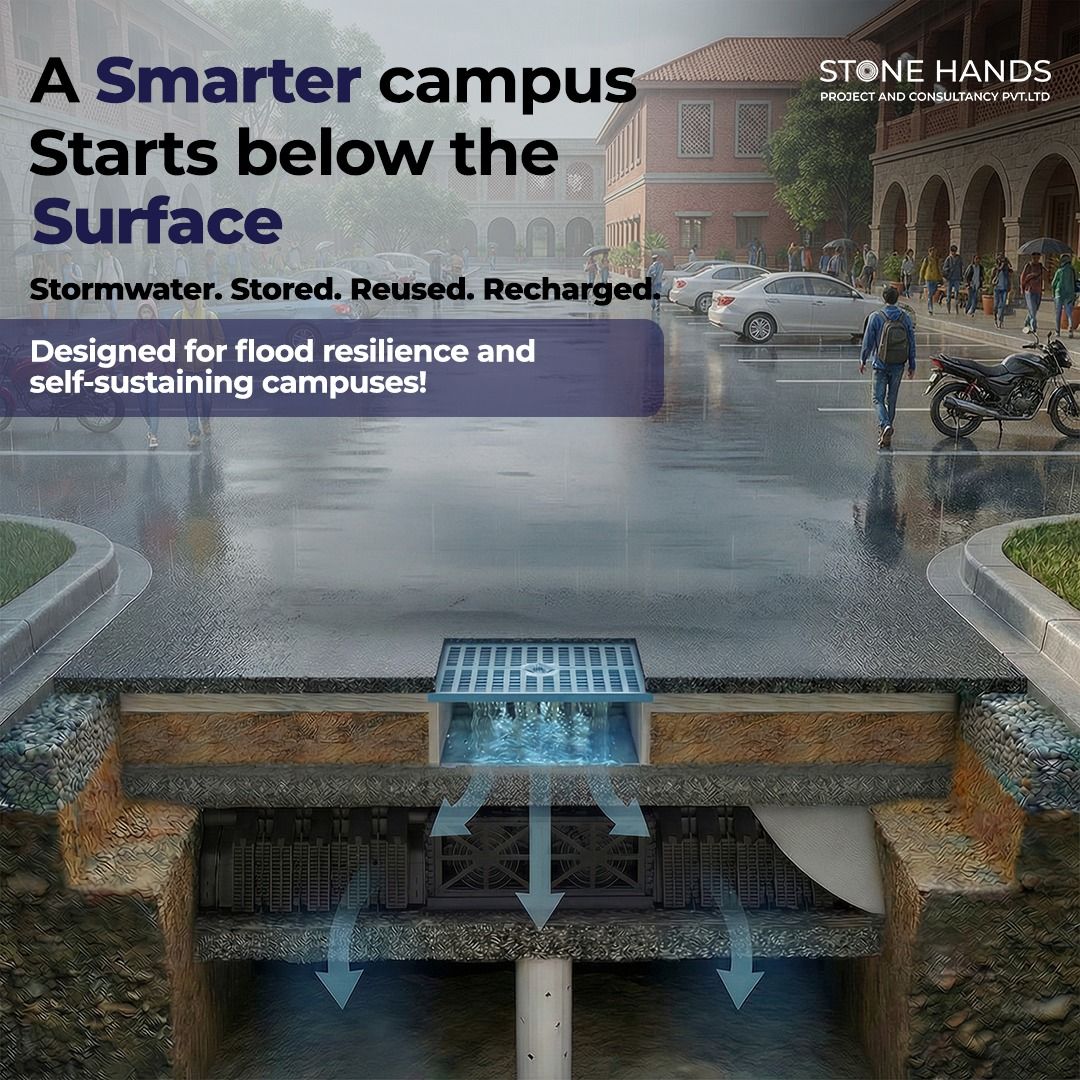
An educational campus — university, college, or school — is a microcosm of an urban area. It has roads, parking, buildings, open spaces, sports facilities, and significant hard-surfaced areas generating stormwater during every rain event. It also has green spaces offering natural opportunities for water management. When designed with Sponge Park infrastructure principles, an educational campus can manage its own stormwater entirely on-site — protecting against flooding, recharging groundwater, and earning the green campus credentials increasingly valued by accreditation bodies. Stone Hands brings this capability to Indian campuses through Eco Bloc-based SuDS systems.
The Problem — Campuses as Unmanaged Catchments
A typical campus of 20–50 acres generates substantial stormwater from: roofed buildings (lecture halls, hostels, admin blocks), roads and driveways, car parks, sports courts, paved plazas. Without stormwater management, all discharges to municipal drain simultaneously — contributing to downstream flooding and providing no on-site benefit. Campuses also consume significant water for irrigation that could largely be met by harvested stormwater.
Water-Sensitive Campus Design
A water-sensitive campus:
• Captures runoff from all hard surfaces into subsurface storage
• Uses stored water for landscape irrigation and toilet flushing
• Provides groundwater recharge through permeable zones
• Eliminates surface flooding in car parks, sports facilities, and access roads
• Functions as green infrastructure demonstration for student learning
Eco Bloc in Campus Applications
Beneath car parks: large, impervious, underutilised during non-peak hours — substantial storage with no surface impact.
Beneath sports facilities: eliminates waterlogging, extends usable season.
Under pedestrian plazas: concentrated runoff managed efficiently and invisibly.
Roof downpipe connection: all building downpipes connected to subsurface system — dramatically increases harvested volume.
https://stonehands.in/solutions
Green Campus Credentials
Water management is a scored criterion in NAAC, NIRF, LEED India, and IGBC Green Campus frameworks. A documented, functional stormwater management system:
• Contributes to LEED and IGBC water credits
• Supports NAAC environmental sustainability criteria
• Provides ongoing data for reporting (volume managed, recharge achieved)
FAQs
Can harvested stormwater be reused for campus irrigation?
A: Yes. Eco Bloc connects to collection sump for pumped irrigation reuse.
Does this require specialist operation by campus maintenance teams?
A: No. Simple O&M protocol manageable by any campus maintenance team.
Can this be implemented in phases?
A: Yes. Priority zones installed first, expanded in subsequent construction phases.
How does this contribute to NAAC or LEED certification?
A: Stone Hands provides documentation of system design, volumes managed, and recharge achieved — formatted for NAAC, LEED, or IGBC submissions.
Can the system be installed beneath an existing campus car park?
A: Yes, but requires excavation and reinstatement — most cost-effective during a planned resurfacing project.
What is the approximate system size for a 30-acre campus?
A: A 30-acre campus with 40% hard surface in Chennai-rainfall zone typically requires 200–500 cubic metres of underground storage. Stone Hands calculates precisely for each project.
CTA: Planning a new campus or upgrading an existing one? Contact Stone Hands for a water-sensitive design assessment.
→ https://stonehands.in/solutions
Contact Us
Join us to
Shape a Water secure future
We'd love to hear from you. Fill out the form and our team will get back to you within 24–48 hours.
Prefer a Direct Approach?
+91 82200 02200
Contact@stonehands.in